

Need Help Grading Homeschool Assignments? My Best Tips for New Homeschool Moms
Grading homeschool assignments doesn’t have to be complicated. As a homeschool parent, you have flexibility in deciding what to grade, how to calculate grades, and when to let your child redo an assignment. The way you grade can also change as your child moves from elementary school to middle school and high school.
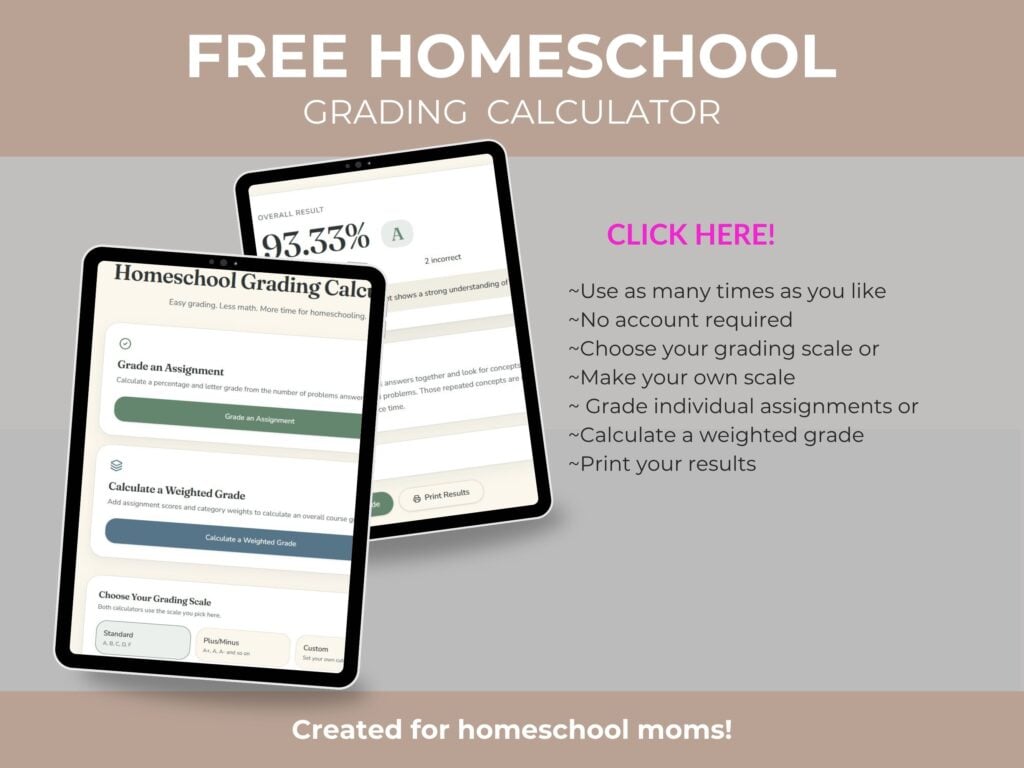
Grading can be one of those necessary evils in the homeschool world. You don’t really want to do it. You are already spending time on the school day teaching and doing everything else that needs to be done. You are there one-on-one with your children and you have first hand knowledge of how they are doing. And yet, they still need those grades.
If you use any online programs for your children, I am guessing most of the assignments your children complete are automatically graded. Please keep reading, because you may not always agree with those grades, and I have some tips for that as well.
In my last post, I talked about how technology is actually hurting our children when they spend too much time using computers, tablets, or phones especially for school. Please go read that post Here or listen to the podcast episode here and watch the YouTube video that is linked there if you have not already done so. I think it is some very eye-opening information that may change the way you look at technology when it comes to educating your children and also using it in their free time.
Grading Homeschool Assignments-My Experience
So, I guess I could say, I was very blessed to not have to deal with so much technology as I homeschooled my children. Of course, there were cell phones and computers, but they were not as widely used as they are today. My husband had a cell phone before we even had children, but I didn’t have one myself until my children were older. None of my children were on our phone plan until they were old enough to pay for their own phones.
We always had a computer, but the children were not on it until they were older except to type up their own stories or something like that. Now we did have a video game console, so I guess that was the extent of the screen time. My point in mentioning all that is to say I was the one figuring out all their grades for much of the time I homeschooled my children.
How Should You Grade Homeschool Assignments?
I am going to come right out and say this, but your child should never fail any subject. Unless they are outright disobeying and not doing their work it should never happen. If they are acting this way then maybe you should get the failing grade and not them. Ouch! Yes, I said it.
If it is a behavior problem then that’s something else that needs to be addressed, but not in this blog post. Unfortunately, I’m not the behavior expert.
The reason they should never fail any subject is simply because you should let them keep trying until they understand and can get a good grade. It’s that simple.
In a school setting, teachers don’t have this flexibility. They are only afforded so much time on a certain subject or a certain topic. If it’s not understood within that time frame, that’s too bad. A child just gets stuck with a lower grade. They didn’t understand the topic in the allotted time.
When a child is homeschooled, you have the flexibility to give your child a little more time and space for things they can’t fully grasp as quickly as others might.
The Law When Grading Homeschool Assignments
Before I get into the nitty gritty of grading, I need to mention that you need to follow the laws where you live. If your state or country requires certain grades to be calculated or reported a certain way, then by all means, do what it required, but take all the little nuggets from this blog post and apply them where you can.

Grading Homeschool Assignments During the Elementary Years
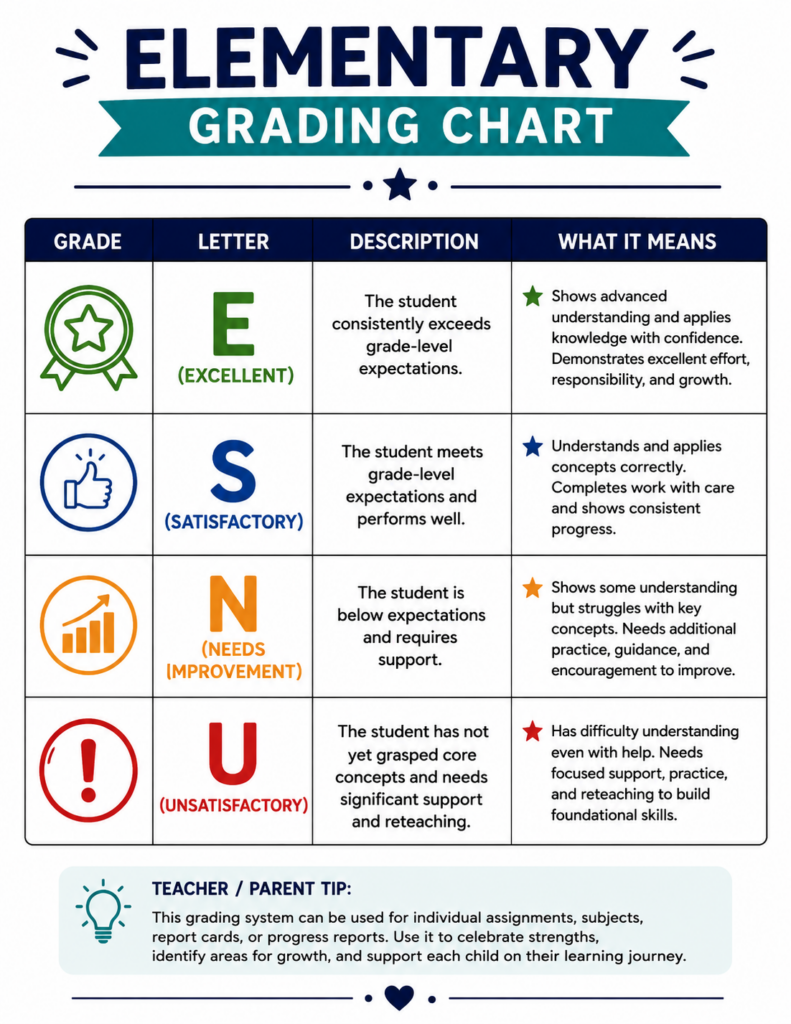
The elementary years are probably when you have the most flexibility with grading. You don’t necessarily need to put a number or percentage grade on every assignment, especially during preschool, kindergarten, first grade, and second grade.
You might use a simple system such as:
- E for Excellent
- S for Satisfactory
- N for Needs Improvement
You can also evaluate things that aren’t easily measured with a traditional percentage. Is your child improving in handwriting? Are they learning their math facts? Can they tell you what happened in the story you just read? Are they becoming more independent with their work?
Remember that the purpose of grading at this age isn’t to create a perfect report card. It’s to help you see what your child understands and where they need more instruction or practice.
You could continue with a simple evaluation system throughout the elementary years if that works for your homeschool.
I started using a more traditional percentage-based grading system with my children at around third grade.
For example:
90–100 = A
80–89 = B
70–79 = C
And so on.
You can customize your grading scale, but I recommend keeping a reasonable standard so your child learns to put effort into their work and work toward improvement.
Here’s a simple grading scale example:
Grading Homeschool Assignments During the Middle School Years
By middle school, I think it’s helpful to become more consistent with grading. Your child is older and can begin understanding that a grade isn’t a label.
A low grade doesn’t mean:
“I’m bad at math.”
Or:
“I’m not smart.”
It simply tells you and your child that there is room for improvement.
Maybe your child needs to review the lesson. Maybe they misunderstood one part of the concept. Maybe they need more practice. That’s useful information!
Let them review the material, correct their mistakes, and when appropriate, try the assignment or test again.
As my children got older, I was honest with them when I thought they needed more practice. If they weren’t ready, we reviewed the material before they took the test again.
That’s what grading should help us discover:
Has my child learned this well enough to move on?
Every child is different, so you’ll still need to consider your individual child’s abilities and learning style.
Also, be especially careful with seventh- and eighth-grade courses that might qualify for high school credit in your state. If your child takes a high-school-level course during middle school, you may need to keep those grades for future transcripts.
Check your state’s requirements so you know which courses and grades you need to document.
How to Calculate Homeschool High School Grades
High school is when keeping accurate grades becomes especially important. You’ll want to have a plan for what you’re grading and how you’re calculating the final course grade. There are a couple of ways you can do this.
Option 1: Average All the Assignment Grades
This is probably the simplest method.
Give your child a grade for each assignment, quiz, paper, or test that you decide to grade.
At the end of the course, add the grades together and divide the total by the number of graded assignments. That gives you the child’s average for the course.
This is similar to what I did with my own children. I used a teacher grade book and recorded the grades for their assignments throughout the year.
Option 2: Use Weighted Grades
Another option is to make certain types of work worth more than others.
For example, you might decide:
- Daily assignments = 25%
- Quizzes = 20%
- Papers or projects = 25%
- Tests = 30%
Those numbers are just examples. You can decide what makes sense for the particular course.
Weighted grading can be especially useful for high school students who plan to attend college because it introduces them to the way many college courses are graded.
Keep Good Records During the High School Years
If your child plans to attend college, grades and GPA become especially important.
You’ll need to keep track of courses, final grades, credits, and the information you’ll eventually need for your child’s high school transcript.
I kept cumulative records for each of my children.
I had one record for first through eighth grade and another for ninth through twelfth grade. These records listed their subjects and final grades for each school year.
Keeping up with this information as you go is much easier than trying to reconstruct four years of high school after your child is ready to graduate!
Your Child Doesn’t Always Have to Complete Every Problem
Here’s one of my favorite benefits of homeschooling:
You don’t necessarily have to make your child complete every problem on an assignment.
Suppose a math lesson has 50 problems, and most of those problems are practicing the exact same concept. Does your child really need to do all 50? Maybe not.
There were many times when I allowed my children to complete every other problem. If there were 50 problems, they might complete 25. I would then grade those 25 problems as the complete assignment. If they did well, great. They had demonstrated that they understood the concept.
If they missed too many, I could have them complete the remaining problems the next day for additional practice. That’s the flexibility of homeschooling.
Instead of asking:
“Did my child complete every problem?”
Ask:
“Does my child understand what this assignment was supposed to teach?”
Those are two very different things.
What About Grades From Online Homeschool Programs?
If your child uses an online homeschool program, remember that you are still the parent and teacher. An automatically generated grade doesn’t always have to be the final word.
If the program allows you to manually change grades, you may decide to adjust a grade after your child has corrected mistakes, reviewed the lesson, or demonstrated that they now understand the material.
My youngest son used Teaching Textbooks for high school math. When he missed a problem, he would go back and correct it. I also had him write down why he had gotten the problem wrong.
That was important because I didn’t want him to simply find the correct answer. I wanted him to understand his mistake.
Once he corrected the problems and could explain why his previous attempts were wrong, I could go into the program and change the grade for that assignment.
If the online homeschool program you use doesn’t allow you to adjust grades, you can always keep your own grade book outside of the program.
It takes a little more work, but it allows you to keep a more accurate record of what your child actually learned.
Don’t Give Your Child a Grade They Didn’t Earn
There is an important difference between allowing your child to earn a better grade and simply giving them one. Don’t manipulate your child’s grades to make the transcript or report card look better.
If your child hasn’t completed the work or doesn’t understand the concepts, giving them an artificially high grade doesn’t help them. Instead, give them another opportunity to learn.
Let them correct the assignment. Review the lesson. Give them more practice. Then, let them take the test again when appropriate.
When they demonstrate that they understand the material, they have earned that better grade.
Keep Paper Copies of Important Homeschool Records
Even if you use an online homeschool program or digital grade book, I strongly recommend keeping paper copies of important homeschool records.
We sometimes assume that because something is stored online, it will always be there. That’s not necessarily true. Companies close. Websites change. Accounts get lost. Programs are discontinued. Information can disappear.
I recommend keeping paper records of your children’s grades and coursework for each school year, especially during the high school years. You may never need those records. But if you do, you’ll be glad you kept them.
Remember What Homeschool Grades Are Really For
Grading doesn’t have to make your homeschool feel like a traditional classroom. A grade is simply information.
It can tell you:
My child understands this.
Or:
We need to spend a little more time here.
That’s one of the greatest advantages we have as homeschool parents. We don’t necessarily have to move on because a calendar says it’s time for the next lesson. We can slow down. We can review. We can practice. And then we can move forward when our children are ready.
The goal isn’t simply to get a good grade.
The goal is learning.
I would love to hear from you! Find me on instagram orfacebook.
Or email me directly: Mary@whatabouthomeschooling.com
Please ask me all your homeschool questions.
Wishing you all the best in your homeschool journey!
~Mary
“…And the sweetness of the lips increaseth learning.” ~Prov. 16:31
As an Amazon associate, I earn from qualified purchases.